Digital Transformation Mistake: Data Collection vs. Service Innovation in Business Models
Discover why digitalization isn’t about data collection — it’s the promise of innovative services driving business growth. Learn strategic development tips to avoid common pitfalls, unlock real value.


Pretext
Imagine this: You’re at a lavish buffet, piling your plate high with every delicacy in sight, only to realize you’ve forgotten to actually eat and savor the meal. That’s precisely what many businesses do with digitalization — they collect mountains of data like eager squirrels stashing nuts for winter, but then what? If you’re nodding along, thinking, “Guilty as charged,” don’t worry; you’re in good company.

But let’s chat about why this is a fundamental mistake and how we can flip the script. Today, right at the start of 2026, I’m excited to dive into this topic with you, sharing my clear opinion that digitalization isn’t about amassing data; it’s about the bold promise to transform that data into groundbreaking services. And at the heart of this transformation?
Strategic business development, with its unique flair for turning possibilities into profitable realities.

The Fundamental Mistake: Treating Data as the Endgame
Let’s start with a candid admission: In our rush to “go digital,” too many organizations fall into the trap of equating digitalization with mere data collection. Picture a company investing millions in sensors, apps, and databases, only to end up with a digital junk drawer overflowing with unused insights. It’s like buying a Ferrari and leaving it in the garage — impressive on paper, but utterly pointless in practice. I firmly believe this mindset is not just shortsighted; it’s a strategic blunder that stifles growth.

Why does this happen? Often, it’s rooted in a fear of missing out (FOMO, anyone?) or a misunderstanding of what digitalization truly entails. Data, after all, is raw and inert — it’s the clay, not the sculpture. Collecting it without a clear purpose leads to silos, compliance headaches, and wasted resources.
But here’s the motivating twist:
What if we viewed data not as a commodity to hoard, but as the fuel for innovation?
That’s where the real magic begins. Instead of asking, “How much data can we gather?” let’s proactively shift to, “What promises can we make to our customers based on this data?”
This proactive pivot isn’t just smart; it’s essential for staying ahead in a competitive landscape where agility reigns supreme.
The Real Business Model: Promising — and Delivering — New Services
Now, let’s get to the heart of it: The business model in digitalization is the promise to develop new services based on the data. This isn’t hyperbole; it’s a game-changer. Think about it — companies like Netflix didn’t win by collecting viewing habits alone; they promised (and delivered) personalized recommendations that keep us binge-watching till dawn. Or consider Uber: Their data on traffic and rider patterns isn’t just stored; it’s leveraged to promise seamless, efficient mobility services that disrupt entire industries.
In my opinion, this promise is what builds trust and loyalty. It’s a commitment to value creation, where data becomes the foundation for services that solve real problems, delight users, and open new revenue streams. Humorously, if data collection were a party, the promise of new services is the DJ that gets everyone dancing — without it, you’re just standing awkwardly in a room full of potential.

To make this solution-oriented, here’s how you can operationalize it:
Identify Pain Points Proactively: Engage in dialogue with your customers. What unmet needs can your data address? For instance, a retailer might use purchase data not just for inventory, but to promise hyper-personalized shopping experiences via AI-driven virtual stylists.
Innovate Outside the Box: Don’t limit yourself to incremental improvements. What if your manufacturing data promised predictive maintenance services that prevent downtime for clients? That’s turning data into a subscription-based lifeline.
Measure Success Holistically: Track not just data volume, but service adoption rates, customer satisfaction, and ROI from those innovations. This ensures your promises aren’t empty — they’re profitable.
By focusing on services, you’re not just digitalizing; you’re revolutionizing your business model. And trust me, that’s far more exhilarating than staring at spreadsheets.
The Special Nature of Strategic Business Development in This Process
Now we’re talking about the unsung hero: strategic business development. This isn’t your run-of-the-mill planning; it’s a dynamic, multifaceted process uniquely suited to bridging the gap between data and deliverable services. What makes it special? Let’s break it down in a way that’s both professional and engaging — after all, strategy shouldn’t be stuffy; it should spark excitement.
First, strategic business development demands a visionary outlook. Unlike tactical data management, it involves forecasting trends, assessing risks, and crafting ecosystems where data fuels collaborative partnerships. Imagine partnering with tech startups to co-develop services — that’s innovative thinking that amplifies your promise. In my view, this foresight is what separates thriving digital enterprises from those stuck in the data-collection rut.
Second, it’s inherently iterative and adaptive. Digitalization evolves rapidly, so business development must incorporate agile methodologies: Test small-scale services, gather feedback, refine, and scale. This dialogue-oriented approach — think regular stakeholder huddles or customer co-creation sessions — ensures your services aren’t just based on data, but refined by real-world input.
Third, it emphasizes ethical and sustainable growth. With data privacy concerns looming (hello, GDPR and beyond), strategic development uniquely positions you to promise services that are not only innovative but also trustworthy. For example, develop transparent AI services that explain how data is used, turning potential liabilities into competitive advantages.
To highlight its special nature further, consider this table comparing traditional data collection to service-oriented strategic development:
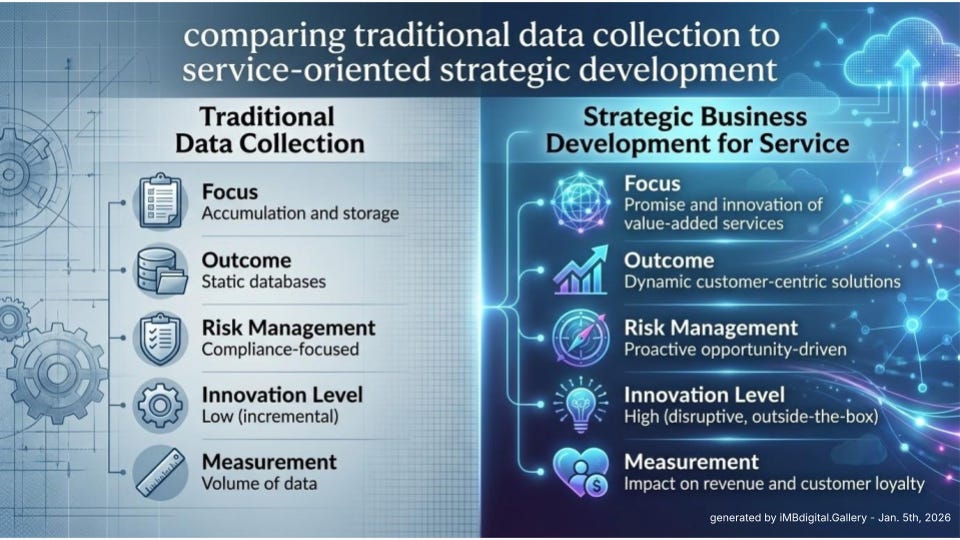
This framework isn’t just theoretical; it’s a practical roadmap.
My strong opinion?
Businesses that integrate strategic development early in their digitalization journey will outpace competitors by leaps and bounds. It’s solution-oriented at its core — identifying opportunities, mitigating pitfalls, and delivering on promises with precision.
Wrapping Up: Your Call to Action in the Digital Frontier
There you have it, dear reader — a fresh perspective on why digitalization transcends data collection and hinges on the exhilarating promise of new services. We’ve laughed at the pitfalls, expressed bold opinions on the misconceptions, and armed you with innovative strategies to excel. But this isn’t the end of our dialogue; it’s the beginning. I encourage you: Audit your current digital efforts today. Are you merely collecting, or are you promising — and pioneering — services that wow?
If you’re feeling motivated (and I hope you are!), let’s think bigger: Share your thoughts in the comments below. What’s one service your data could promise? Remember, the future belongs to those who develop strategically. Go forth and innovate — your business (and your customers) will thank you. — Frank P. Neuhaus